


Current Stern Center Fellows

Alvan Bregman
2026-29 Stern Center Associate Research Fellow
Associate Professor Emeritus, Library Administration, University of Illinois at Urbana-Champaign
Ph.D., University of Toronto
E-mail: ambregman@gmail.com
Alvan Bregman served as Curator of Rare Books and Associate Professor of Library Administration at the University of Illinois Urbana-Champaign before moving on to the position of Department Head in the W.D. Jordan Rare Books and Special Collections Library at Queen’s University in Kingston, Ontario. He was for many years an active member and Chair of the Security Committee of the Rare Books & Manuscripts Section (RBMS) of ACRL/ALA. His publications include the volume Emblemata: The Emblem Books of Andrea Alciato (Bird & Bull Press, 2007), and numerous articles on diverse bibliographical subjects, including early modern medicine and mathematics, emblem books, the Elizabethan scholar and annotator Gabriel Harvey and Reynard the Fox. For the past fifteen years he has worked closely with Earle Havens, Stern Center Director reconstructing the lost and otherwise scattered library of over 5,000 ephemera collected and annotated in manuscript by the London parliamentarian, diarist, and bibliophile Narcissus Luttrell (1657-1732). Together they received a $318,000 grant from the National Endowment for the Humanities to complete that project and implement an on-line relational database and research tools in 2027.
Alvan Bregman
2026-29 Stern Center Associate Research Fellow
Associate Professor Emeritus, Library Administration, University of Illinois at Urbana-Champaign
Ph.D., University of Toronto
E-mail: ambregman@gmail.com
Alvan Bregman served as Curator of Rare Books and Associate Professor of Library Administration at the University of Illinois Urbana-Champaign before moving on to the position of Department Head in the W.D. Jordan Rare Books and Special Collections Library at Queen’s University in Kingston, Ontario. He was for many years an active member and Chair of the Security Committee of the Rare Books & Manuscripts Section (RBMS) of ACRL/ALA. His publications include the volume Emblemata: The Emblem Books of Andrea Alciato (Bird & Bull Press, 2007), and numerous articles on diverse bibliographical subjects, including early modern medicine and mathematics, emblem books, the Elizabethan scholar and annotator Gabriel Harvey and Reynard the Fox. For the past fifteen years he has worked closely with Earle Havens, Stern Center Director reconstructing the lost and otherwise scattered library of over 5,000 ephemera collected and annotated in manuscript by the London parliamentarian, diarist, and bibliophile Narcissus Luttrell (1657-1732). Together they received a $318,000 grant from the National Endowment for the Humanities to complete that project and implement an on-line relational database and research tools in 2027.
Alvan Bregman
2026-29 Stern Center Associate Research Fellow
Associate Professor Emeritus, Library Administration, University of Illinois at Urbana-Champaign
Ph.D., University of Toronto
E-mail: ambregman@gmail.com
Alvan Bregman served as Curator of Rare Books and Associate Professor of Library Administration at the University of Illinois Urbana-Champaign before moving on to the position of Department Head in the W.D. Jordan Rare Books and Special Collections Library at Queen’s University in Kingston, Ontario. He was for many years an active member and Chair of the Security Committee of the Rare Books & Manuscripts Section (RBMS) of ACRL/ALA. His publications include the volume Emblemata: The Emblem Books of Andrea Alciato (Bird & Bull Press, 2007), and numerous articles on diverse bibliographical subjects, including early modern medicine and mathematics, emblem books, the Elizabethan scholar and annotator Gabriel Harvey and Reynard the Fox. For the past fifteen years he has worked closely with Earle Havens, Stern Center Director reconstructing the lost and otherwise scattered library of over 5,000 ephemera collected and annotated in manuscript by the London parliamentarian, diarist, and bibliophile Narcissus Luttrell (1657-1732). Together they received a $318,000 grant from the National Endowment for the Humanities to complete that project and implement an on-line relational database and research tools in 2027.

Leib Celnik
2026-27 Stern Center Curatorial Fellow
PhD candidate, Department of History of Science and Technology, Johns Hopkins University.
E-mail: lcelnik1@jhu.edu
Leib Celnik’s dissertation focuses on the history of art conservation in North America and Europe, tracing the field’s development to understand the adoption of scientific methods and rhetoric within the field during the nineteenth and twentieth centuries. He is broadly interested in the history of the physical sciences, museum studies, and material culture studies. In 2025 his chapter on the history of the Smithsonian Institution’s Conservation Analytical Laboratory was published by Brill in the volume The Invention of Scientific Conservation: Expert Cultures of Conservation after the Second World War. Leib holds degrees from Harvard University and the University of Cambridge, and has worked closely with a range of museums including the Harvard Art Museums, Dumbarton Oaks, and most recently, the Baltimore Museum of Art.
Leib Celnik’s Curatorial Fellowship was generously funded by Harriett Long.
Leib Celnik
2026-27 Stern Center Curatorial Fellow
PhD candidate, Department of History of Science and Technology, Johns Hopkins University.
E-mail: lcelnik1@jhu.edu
Leib Celnik’s dissertation focuses on the history of art conservation in North America and Europe, tracing the field’s development to understand the adoption of scientific methods and rhetoric within the field during the nineteenth and twentieth centuries. He is broadly interested in the history of the physical sciences, museum studies, and material culture studies. In 2025 his chapter on the history of the Smithsonian Institution’s Conservation Analytical Laboratory was published by Brill in the volume The Invention of Scientific Conservation: Expert Cultures of Conservation after the Second World War. Leib holds degrees from Harvard University and the University of Cambridge, and has worked closely with a range of museums including the Harvard Art Museums, Dumbarton Oaks, and most recently, the Baltimore Museum of Art.
Leib Celnik’s Curatorial Fellowship was generously funded by Harriett Long.
Kelsey Champagne
2023-26 Stern Center Associate Research Fellow
2021-23 Stern Center Postdoctoral Fellow
Assistant Professor, Departments of History and Museum Studies, St. Mary’s College of Maryland
Ph.D., Yale University
E-mail: kchampa3@jhu.edu
Website
Kelsey Champagne (JHU ’15) earned a Ph.D. in History and Renaissance Studies from Yale University in 2021, where she wrote a dissertation on the resilience of Catholic communities in Scotland, Maryland, and the West Indies in the face of severe persecution at the hands of British imperial power. She then returned to JHU as the 2021-23 Stern Center Postdoctoral Fellow, where she was involved in all academic and public programming for the Center, including organizing lectures, conferences, and international master classes, teaching undergraduates, and mentoring PhD candidates interested in the field of curatorship. Dr. Champagne also worked as Co-Curator of the Women of the Book exhibition, highlighting the intersection between spirituality and the written word across media in the lives of early modern Catholic women. She is currently studying the material culture, ritual practices, and economic history of a Florentine convent in the mid-18th century from a diary and inventory meticulously recorded by the convent’s keeper of the Christmas presepio in the Women of the Book collection. Dr. Champagne has recently begun a post as Assistant Professor of Atlantic & Public History at St. Mary’s College, Maryland.
Leib Celnik
2026-27 Stern Center Curatorial Fellow
PhD candidate, Department of History of Science and Technology, Johns Hopkins University.
E-mail: lcelnik1@jhu.edu
Leib Celnik’s dissertation focuses on the history of art conservation in North America and Europe, tracing the field’s development to understand the adoption of scientific methods and rhetoric within the field during the nineteenth and twentieth centuries. He is broadly interested in the history of the physical sciences, museum studies, and material culture studies. In 2025 his chapter on the history of the Smithsonian Institution’s Conservation Analytical Laboratory was published by Brill in the volume The Invention of Scientific Conservation: Expert Cultures of Conservation after the Second World War. Leib holds degrees from Harvard University and the University of Cambridge, and has worked closely with a range of museums including the Harvard Art Museums, Dumbarton Oaks, and most recently, the Baltimore Museum of Art.
Leib Celnik’s Curatorial Fellowship was generously funded by Harriett Long.

Kelsey Champagne
2023-26 Stern Center Associate Research Fellow
2021-23 Stern Center Postdoctoral Fellow
Assistant Professor, Departments of History and Museum Studies, St. Mary’s College of Maryland
Ph.D., Yale University
E-mail: kechampagne@smcm.edu
Website
Kelsey Champagne (JHU ’15) earned a Ph.D. in History and Renaissance Studies from Yale University in 2021, where she wrote a dissertation on the resilience of Catholic communities in Scotland, Maryland, and the West Indies in the face of severe persecution at the hands of British imperial power. She then returned to JHU as the 2021-23 Stern Center Postdoctoral Fellow, where she was involved in all academic and public programming for the Center, including organizing lectures, conferences, and international master classes, teaching undergraduates, and mentoring PhD candidates interested in the field of curatorship. Dr. Champagne also worked as Co-Curator of the Women of the Book exhibition, highlighting the intersection between spirituality and the written word across media in the lives of early modern Catholic women. She is currently co-editing a book focused on that collection with Earle Havens and Erin Rowe, Women of the Book: The Spiritual Lives of Early Modern Women, 1450-1800 (Pennsylvania State University Press, 2027).
Kelsey Champagne
2023-26 Stern Center Associate Research Fellow
2021-23 Stern Center Postdoctoral Fellow
Assistant Professor, Departments of History and Museum Studies, St. Mary’s College of Maryland
Ph.D., Yale University
E-mail: kechampagne@smcm.edu
Website
Kelsey Champagne (JHU ’15) earned a Ph.D. in History and Renaissance Studies from Yale University in 2021, where she wrote a dissertation on the resilience of Catholic communities in Scotland, Maryland, and the West Indies in the face of severe persecution at the hands of British imperial power. She then returned to JHU as the 2021-23 Stern Center Postdoctoral Fellow, where she was involved in all academic and public programming for the Center, including organizing lectures, conferences, and international master classes, teaching undergraduates, and mentoring PhD candidates interested in the field of curatorship. Dr. Champagne also worked as Co-Curator of the Women of the Book exhibition, highlighting the intersection between spirituality and the written word across media in the lives of early modern Catholic women. She is currently co-editing a book focused on that collection with Earle Havens and Erin Rowe, Women of the Book: The Spiritual Lives of Early Modern Women, 1450-1800 (Pennsylvania State University Press, 2027).
Kelsey Champagne
2023-26 Stern Center Associate Research Fellow
2021-23 Stern Center Postdoctoral Fellow
Assistant Professor, Departments of History and Museum Studies, St. Mary’s College of Maryland
Ph.D., Yale University
E-mail: kechampagne@smcm.edu
Website
Kelsey Champagne (JHU ’15) earned a Ph.D. in History and Renaissance Studies from Yale University in 2021, where she wrote a dissertation on the resilience of Catholic communities in Scotland, Maryland, and the West Indies in the face of severe persecution at the hands of British imperial power. She then returned to JHU as the 2021-23 Stern Center Postdoctoral Fellow, where she was involved in all academic and public programming for the Center, including organizing lectures, conferences, and international master classes, teaching undergraduates, and mentoring PhD candidates interested in the field of curatorship. Dr. Champagne also worked as Co-Curator of the Women of the Book exhibition, highlighting the intersection between spirituality and the written word across media in the lives of early modern Catholic women. She is currently co-editing a book focused on that collection with Earle Havens and Erin Rowe, Women of the Book: The Spiritual Lives of Early Modern Women, 1450-1800 (Pennsylvania State University Press, 2027).

Stephen Clarke
2024-27 Stern Center Associate Research Fellow
Honorary Research Fellow, University of Liverpool
E-mail: stephen.tabards@btinternet.com
Stephen Clarke is a Fellow of the Society of Antiquaries and is the Chair of Dr. Johnson’s House in Gough Square, London, and of the Beckford Society. His central research interest has been Horace Walpole, on which he has published The Strawberry Hill Press & Its Printing House (Lewis Walpole Library, distributed by Yale University Press, 2011) and has edited Walpole’s Selected Letters for Everyman’s Library (2017). His most recent book concerns the Walpole collector and scholar W.S. Lewis, Lefty Lewis and the Waldegraves: Collecting, Obsession, Friendship, published by The Book Collector in 2022.
He also works on Samuel Johnson, Thomas Gray, antiquarianism, book history, and architecture / literature connections during the long eighteenth century. He has given talks at the Stern Center on John Evelyn’s architectural taste as formed during his Grand Tour (1643–46), and on an unpublished manuscript of Thomas Gray from his famous Grand Tour with Horace Walpole (1739–41) in the Sheridan Libraries, which will appear in Thomas Gray among the Disciplines (Routledge, 2025). He has two forthcoming essays on Samuel Johnson in The Age of Johnson, and other forthcoming articles on books from William Beckford’s library in The Library, on correspondence of Charles Burney and William Mason in Eighteenth-Century Studies, and on Horace Walpole’s Description of Strawberry Hill in Studies in Bibliography.
Stephen Clarke
2024-27 Stern Center Associate Research Fellow
Honorary Research Fellow, University of Liverpool
E-mail: stephen.tabards@btinternet.com
Stephen Clarke is a Fellow of the Society of Antiquaries and is the Chair of Dr. Johnson’s House in Gough Square, London, and of the Beckford Society. His central research interest has been Horace Walpole, on which he has published The Strawberry Hill Press & Its Printing House (Lewis Walpole Library, distributed by Yale University Press, 2011) and has edited Walpole’s Selected Letters for Everyman’s Library (2017). His most recent book concerns the Walpole collector and scholar W.S. Lewis, Lefty Lewis and the Waldegraves: Collecting, Obsession, Friendship, published by The Book Collector in 2022.
He also works on Samuel Johnson, Thomas Gray, antiquarianism, book history, and architecture / literature connections during the long eighteenth century. He has given talks at the Stern Center on John Evelyn’s architectural taste as formed during his Grand Tour (1643–46), and on an unpublished manuscript of Thomas Gray from his famous Grand Tour with Horace Walpole (1739–41) in the Sheridan Libraries, which will appear in Thomas Gray among the Disciplines (Routledge, 2025). He has two forthcoming essays on Samuel Johnson in The Age of Johnson, and other forthcoming articles on books from William Beckford’s library in The Library, on correspondence of Charles Burney and William Mason in Eighteenth-Century Studies, and on Horace Walpole’s Description of Strawberry Hill in Studies in Bibliography.
Stephen Clarke
2024-27 Stern Center Associate Research Fellow
Honorary Research Fellow, University of Liverpool
E-mail: stephen.tabards@btinternet.com
Stephen Clarke is a Fellow of the Society of Antiquaries and is the Chair of Dr. Johnson’s House in Gough Square, London, and of the Beckford Society. His central research interest has been Horace Walpole, on which he has published The Strawberry Hill Press & Its Printing House (Lewis Walpole Library, distributed by Yale University Press, 2011) and has edited Walpole’s Selected Letters for Everyman’s Library (2017). His most recent book concerns the Walpole collector and scholar W.S. Lewis, Lefty Lewis and the Waldegraves: Collecting, Obsession, Friendship, published by The Book Collector in 2022.
He also works on Samuel Johnson, Thomas Gray, antiquarianism, book history, and architecture / literature connections during the long eighteenth century. He has given talks at the Stern Center on John Evelyn’s architectural taste as formed during his Grand Tour (1643–46), and on an unpublished manuscript of Thomas Gray from his famous Grand Tour with Horace Walpole (1739–41) in the Sheridan Libraries, which will appear in Thomas Gray among the Disciplines (Routledge, 2025). He has two forthcoming essays on Samuel Johnson in The Age of Johnson, and other forthcoming articles on books from William Beckford’s library in The Library, on correspondence of Charles Burney and William Mason in Eighteenth-Century Studies, and on Horace Walpole’s Description of Strawberry Hill in Studies in Bibliography.

Laura S. DeLuca
2026-27 Stern Center/Renaissance Society of America Visiting Research Fellow
PhD Candidate, Department of English, Carnegie Mellon University.
E-mail: ldeluca@andrew.cmu.edu
Laura DeLuca’s research examines early modern drama, classical reception, book history, and digital humanities, with particular interests in gender, race, and the transmission of classical antiquity. Her dissertation explores representations of ancient queens in early modern literature, examining how these figures shaped competing models of conduct, race, and sexuality on the Renaissance stage.
In addition to her dissertation research, she is a collaborator on Print & Probability, a book history and digital humanities project that uses AI and machine learning to identify the anonymous printers of clandestine publications in early modern Europe. Her work has appeared, or is forthcoming, in Shakespeare Quarterly; Early Theatre; the Journal for Early Modern Cultural Studies; the Society for the History of Authorship, Reading, and Publishing News; the Journal of Statistics and Data Science Education; Digital Studies / Le champ numérique; and Debates in Digital Humanities.
Laura S. DeLuca
2026-27 Stern Center/Renaissance Society of America Visiting Research Fellow
PhD Candidate, Department of English, Carnegie Mellon University.
E-mail: ldeluca@andrew.cmu.edu
Laura DeLuca’s research examines early modern drama, classical reception, book history, and digital humanities, with particular interests in gender, race, and the transmission of classical antiquity. Her dissertation explores representations of ancient queens in early modern literature, examining how these figures shaped competing models of conduct, race, and sexuality on the Renaissance stage.
In addition to her dissertation research, she is a collaborator on Print & Probability, a book history and digital humanities project that uses AI and machine learning to identify the anonymous printers of clandestine publications in early modern Europe. Her work has appeared, or is forthcoming, in Shakespeare Quarterly; Early Theatre; the Journal for Early Modern Cultural Studies; the Society for the History of Authorship, Reading, and Publishing News; the Journal of Statistics and Data Science Education; Digital Studies / Le champ numérique; and Debates in Digital Humanities.
Laura S. DeLuca
2026-27 Stern Center/Renaissance Society of America Visiting Research Fellow
PhD Candidate, Department of English, Carnegie Mellon University.
E-mail: ldeluca@andrew.cmu.edu
Laura DeLuca’s research examines early modern drama, classical reception, book history, and digital humanities, with particular interests in gender, race, and the transmission of classical antiquity. Her dissertation explores representations of ancient queens in early modern literature, examining how these figures shaped competing models of conduct, race, and sexuality on the Renaissance stage.
In addition to her dissertation research, she is a collaborator on Print & Probability, a book history and digital humanities project that uses AI and machine learning to identify the anonymous printers of clandestine publications in early modern Europe. Her work has appeared, or is forthcoming, in Shakespeare Quarterly; Early Theatre; the Journal for Early Modern Cultural Studies; the Society for the History of Authorship, Reading, and Publishing News; the Journal of Statistics and Data Science Education; Digital Studies / Le champ numérique; and Debates in Digital Humanities.

Carme Font-Paz
2023-26 Stern Center Associate Research Fellow
2023-24 Stern Center/RSA Visiting Research Fellow
Associate Professor and ICREA Academia Fellow, Department of English, Universitat Autònoma de Barcelona
Ph.D., Universitat Autònoma de Barcelona
E-mail: Carme.Font@uab.cat
Faculty webpage
WINK project webpage
Twitter accounts: @CFontPaz @ProjectWink
In addition to her teaching and faculty service at the Universitat Autònoma de Barcelona, Dr. Font-Paz is Director of the European Research Council (ERC) funded large-scale project WINK, “Women’s Invisible Ink: Trans-Genre Writing and the Gendering of Intellectual Value in Early Modernity.” She is a specialist in women’s spiritual writings from the sixteenth and the seventeenth centuries at the intersection of Protestant Reformation and Counter-Reformation discourses. Her research also examines the intellectual history of women throughout the early modern period through a comparatist approach, engaging in book history, ephemera, and socio-economic considerations surrounding textual production. Her forthcoming monograph, Women Writing on Social Change in Early Modern Europe (Brepols) brings together this wide range of interests.
Her most recent book publications are Women’s Prophetic Writings in Seventeenth-Century Britain (Routledge, 2017), and, with Nina Geerdink, Economic Imperatives for Women’s Writing in Early Modern Europe (Brill, 2018). She is also editor of the Brepols book series “Early Modern Women Writers in Europe: Texts, Debates and Genealogies of Knowledge.” Since 2018, Dr. Font-Paz has worked closely with the Stern Center on JHU’s Women of the Book Collection, giving several lectures, convening numerous academic conference panels and roundtables, and a contributing to the forthcoming Stern Center book Women of the Book: The Spiritual Lives of Early Modern Women, 1450-1800. In 2023-24, the Stern Center, JHU’s Charles S. Singleton Center for the Study of Premodern Europe, and the WINK project at the Universitat Autònoma de Barcelona initiated a multi-year collaboration and student and faculty exchange between JHU and UAB.
Carme Font-Paz
2023-26 Stern Center Associate Research Fellow
2023-24 Stern Center/RSA Visiting Research Fellow
Associate Professor and ICREA Academia Fellow, Department of English, Universitat Autònoma de Barcelona
Ph.D., Universitat Autònoma de Barcelona
E-mail: Carme.Font@uab.cat
Faculty webpage
WINK project webpage
Twitter accounts: @CFontPaz @ProjectWink
In addition to her teaching and faculty service at the Universitat Autònoma de Barcelona, Dr. Font-Paz is Director of the European Research Council (ERC) funded large-scale project WINK, “Women’s Invisible Ink: Trans-Genre Writing and the Gendering of Intellectual Value in Early Modernity.” She is a specialist in women’s spiritual writings from the sixteenth and the seventeenth centuries at the intersection of Protestant Reformation and Counter-Reformation discourses. Her research also examines the intellectual history of women throughout the early modern period through a comparatist approach, engaging in book history, ephemera, and socio-economic considerations surrounding textual production. Her forthcoming monograph, Women Writing on Social Change in Early Modern Europe (Brepols) brings together this wide range of interests.
Her most recent book publications are Women’s Prophetic Writings in Seventeenth-Century Britain (Routledge, 2017), and, with Nina Geerdink, Economic Imperatives for Women’s Writing in Early Modern Europe (Brill, 2018). She is also editor of the Brepols book series “Early Modern Women Writers in Europe: Texts, Debates and Genealogies of Knowledge.” Since 2018, Dr. Font-Paz has worked closely with the Stern Center on JHU’s Women of the Book Collection, giving several lectures, convening numerous academic conference panels and roundtables, and a contributing to the forthcoming Stern Center book Women of the Book: The Spiritual Lives of Early Modern Women, 1450-1800. In 2023-24, the Stern Center, JHU’s Charles S. Singleton Center for the Study of Premodern Europe, and the WINK project at the Universitat Autònoma de Barcelona initiated a multi-year collaboration and student and faculty exchange between JHU and UAB.
Carme Font-Paz
2023-26 Stern Center Associate Research Fellow
2023-24 Stern Center/RSA Visiting Research Fellow
Associate Professor and ICREA Academia Fellow, Department of English, Universitat Autònoma de Barcelona
Ph.D., Universitat Autònoma de Barcelona
E-mail: Carme.Font@uab.cat
Faculty webpage
WINK project webpage
Twitter accounts: @CFontPaz @ProjectWink
In addition to her teaching and faculty service at the Universitat Autònoma de Barcelona, Dr. Font-Paz is Director of the European Research Council (ERC) funded large-scale project WINK, “Women’s Invisible Ink: Trans-Genre Writing and the Gendering of Intellectual Value in Early Modernity.” She is a specialist in women’s spiritual writings from the sixteenth and the seventeenth centuries at the intersection of Protestant Reformation and Counter-Reformation discourses. Her research also examines the intellectual history of women throughout the early modern period through a comparatist approach, engaging in book history, ephemera, and socio-economic considerations surrounding textual production. Her forthcoming monograph, Women Writing on Social Change in Early Modern Europe (Brepols) brings together this wide range of interests.
Her most recent book publications are Women’s Prophetic Writings in Seventeenth-Century Britain (Routledge, 2017), and, with Nina Geerdink, Economic Imperatives for Women’s Writing in Early Modern Europe (Brill, 2018). She is also editor of the Brepols book series “Early Modern Women Writers in Europe: Texts, Debates and Genealogies of Knowledge.” Since 2018, Dr. Font-Paz has worked closely with the Stern Center on JHU’s Women of the Book Collection, giving several lectures, convening numerous academic conference panels and roundtables, and a contributing to the forthcoming Stern Center book Women of the Book: The Spiritual Lives of Early Modern Women, 1450-1800. In 2023-24, the Stern Center, JHU’s Charles S. Singleton Center for the Study of Premodern Europe, and the WINK project at the Universitat Autònoma de Barcelona initiated a multi-year collaboration and student and faculty exchange between JHU and UAB.

Julianne Mehra
2026-27 Stern Center Curatorial Fellow
PhD candidate, Department of Modern Languages and Literatures, French Division, Johns Hopkins University
E-mail: jmehra2@jhu.edu
Working at the intersection of literature, rhetoric, theater, and performance, Julianne Mehra’s research examines theories of the sublime and aesthetic judgment in seventeenth- and eighteenth-century France. Her dissertation traces the development of a comic sublime, uncovering an alternative tradition of sublimity grounded in reflection, self-recognition, and humility, rather than the more canonical models associated with terror, transcendence, and grandeur. She has also presented research on Enlightenment theories of discernment in relation to contemporary questions surrounding artificial intelligence and the future of critical thinking.
Julianne has written articles on the art criticism of Denis Diderot and on eighteenth-century aesthetic theory. Her research interests also include medieval theories of revelation, ekphrasis, the rhetoric of the French Revolution, and Haitian Vodou. Within these areas, she is particularly interested in the role of repetition in producing meaning across ritual, dance, religion, and political performance. Across these fields, her work investigates process-oriented models of aesthetic experience and judgment, particularly the ways in which literary and artistic forms reshape perception over time.
Prior to coming to JHU, Julianne graduated magna cum laude and Phi Beta Kappa from Dartmouth College with a BA in Comparative Literature, where she completed an interdisciplinary thesis on music and literature in the French Enlightenment.
Julianne Mehra’s Curatorial Fellowship was generously funded by Mark McConnell.
Julianne Mehra
2026-27 Stern Center Curatorial Fellow
PhD candidate, Department of Modern Languages and Literatures, French Division, Johns Hopkins University
E-mail: jmehra2@jhu.edu
Working at the intersection of literature, rhetoric, theater, and performance, Julianne Mehra’s research examines theories of the sublime and aesthetic judgment in seventeenth- and eighteenth-century France. Her dissertation traces the development of a comic sublime, uncovering an alternative tradition of sublimity grounded in reflection, self-recognition, and humility, rather than the more canonical models associated with terror, transcendence, and grandeur. She has also presented research on Enlightenment theories of discernment in relation to contemporary questions surrounding artificial intelligence and the future of critical thinking.
Julianne has written articles on the art criticism of Denis Diderot and on eighteenth-century aesthetic theory. Her research interests also include medieval theories of revelation, ekphrasis, the rhetoric of the French Revolution, and Haitian Vodou. Within these areas, she is particularly interested in the role of repetition in producing meaning across ritual, dance, religion, and political performance. Across these fields, her work investigates process-oriented models of aesthetic experience and judgment, particularly the ways in which literary and artistic forms reshape perception over time.
Prior to coming to JHU, Julianne graduated magna cum laude and Phi Beta Kappa from Dartmouth College with a BA in Comparative Literature, where she completed an interdisciplinary thesis on music and literature in the French Enlightenment.
Julianne Mehra’s Curatorial Fellowship was generously funded by Mark McConnell.
Julianne Mehra
2026-27 Stern Center Curatorial Fellow
PhD candidate, Department of Modern Languages and Literatures, French Division, Johns Hopkins University
E-mail: jmehra2@jhu.edu
Working at the intersection of literature, rhetoric, theater, and performance, Julianne Mehra’s research examines theories of the sublime and aesthetic judgment in seventeenth- and eighteenth-century France. Her dissertation traces the development of a comic sublime, uncovering an alternative tradition of sublimity grounded in reflection, self-recognition, and humility, rather than the more canonical models associated with terror, transcendence, and grandeur. She has also presented research on Enlightenment theories of discernment in relation to contemporary questions surrounding artificial intelligence and the future of critical thinking.
Julianne has written articles on the art criticism of Denis Diderot and on eighteenth-century aesthetic theory. Her research interests also include medieval theories of revelation, ekphrasis, the rhetoric of the French Revolution, and Haitian Vodou. Within these areas, she is particularly interested in the role of repetition in producing meaning across ritual, dance, religion, and political performance. Across these fields, her work investigates process-oriented models of aesthetic experience and judgment, particularly the ways in which literary and artistic forms reshape perception over time.
Prior to coming to JHU, Julianne graduated magna cum laude and Phi Beta Kappa from Dartmouth College with a BA in Comparative Literature, where she completed an interdisciplinary thesis on music and literature in the French Enlightenment.
Julianne Mehra’s Curatorial Fellowship was generously funded by Mark McConnell.

Daniel T. McClurkin
2024-27 Stern Center Associate Research Fellow
2023-24 Stern Center Postdoctoral Fellow
Ph.D., Johns Hopkins University
E-mail: daniel.mcclurkin@ell.ox.ac.uk, dtmcclurkin@gmail.com
Daniel T. McClurkin’s research interests encompass transnational textual cultures, book history, and early modern Ireland. His dissertation focused on the production of an Irish national consciousness in the sixteenth and seventeenth centuries. In addition to his work on early modern Ireland, Dr. McClurkin’s research interests extend to the reception of the early modern period, nostalgia and melancholia in modern literature, genre theory, and the intersection between settler colonization and literary production.
At Johns Hopkins, Dr. McClurkin taught courses on Irish Literature from the medieval to the contemporary, John Milton’s poetry, J.R.R. Tolkien’s medieval scholarship, and representations of grief and mourning in Anglophone literature. He was also associated with the Center for Digital Humanities at Johns Hopkins, assisting Tom Lippincott with the development of unsupervised neural architectures applied to the analysis of large datasets pertaining to early modern English textual representation of the Irish.
Now based at Campion Hall, University of Oxford, Dr. McClurkin serves as managing editor of the five-volume Complete Works of Robert Southwell for Oxford University Press. At Oxford, he lectures in early modern English literature, and teaches for both the History and English, and the Classics and English, joint schools. He also continues to work as an Associate Research Fellow of the Stern Center, collaborating on the NEH-funded grant project “The Luttrell File,” focused on early modern ephemera bearing contemporary manuscript annotations.
Daniel T. McClurkin
2024-27 Stern Center Associate Research Fellow
2023-24 Stern Center Postdoctoral Fellow
Ph.D., Johns Hopkins University
E-mail: daniel.mcclurkin@ell.ox.ac.uk, dtmcclurkin@gmail.com
Daniel T. McClurkin’s research interests encompass transnational textual cultures, book history, and early modern Ireland. His dissertation focused on the production of an Irish national consciousness in the sixteenth and seventeenth centuries. In addition to his work on early modern Ireland, Dr. McClurkin’s research interests extend to the reception of the early modern period, nostalgia and melancholia in modern literature, genre theory, and the intersection between settler colonization and literary production.
At Johns Hopkins, Dr. McClurkin taught courses on Irish Literature from the medieval to the contemporary, John Milton’s poetry, J.R.R. Tolkien’s medieval scholarship, and representations of grief and mourning in Anglophone literature. He was also associated with the Center for Digital Humanities at Johns Hopkins, assisting Tom Lippincott with the development of unsupervised neural architectures applied to the analysis of large datasets pertaining to early modern English textual representation of the Irish.
Now based at Campion Hall, University of Oxford, Dr. McClurkin serves as managing editor of the five-volume Complete Works of Robert Southwell for Oxford University Press. At Oxford, he lectures in early modern English literature, and teaches for both the History and English, and the Classics and English, joint schools. He also continues to work as an Associate Research Fellow of the Stern Center, collaborating on the NEH-funded grant project “The Luttrell File,” focused on early modern ephemera bearing contemporary manuscript annotations.
Daniel T. McClurkin
2024-27 Stern Center Associate Research Fellow
2023-24 Stern Center Postdoctoral Fellow
Ph.D., Johns Hopkins University
E-mail: daniel.mcclurkin@ell.ox.ac.uk, dtmcclurkin@gmail.com
Daniel T. McClurkin’s research interests encompass transnational textual cultures, book history, and early modern Ireland. His dissertation focused on the production of an Irish national consciousness in the sixteenth and seventeenth centuries. In addition to his work on early modern Ireland, Dr. McClurkin’s research interests extend to the reception of the early modern period, nostalgia and melancholia in modern literature, genre theory, and the intersection between settler colonization and literary production.
At Johns Hopkins, Dr. McClurkin taught courses on Irish Literature from the medieval to the contemporary, John Milton’s poetry, J.R.R. Tolkien’s medieval scholarship, and representations of grief and mourning in Anglophone literature. He was also associated with the Center for Digital Humanities at Johns Hopkins, assisting Tom Lippincott with the development of unsupervised neural architectures applied to the analysis of large datasets pertaining to early modern English textual representation of the Irish.
Now based at Campion Hall, University of Oxford, Dr. McClurkin serves as managing editor of the five-volume Complete Works of Robert Southwell for Oxford University Press. At Oxford, he lectures in early modern English literature, and teaches for both the History and English, and the Classics and English, joint schools. He also continues to work as an Associate Research Fellow of the Stern Center, collaborating on the NEH-funded grant project “The Luttrell File,” focused on early modern ephemera bearing contemporary manuscript annotations.

Mark McConnell
2026-29 Stern Center Associate Research Fellow
Independent Scholar and Antiquarian Book Collector, Washington, DC
E-mail: mark@cooperpoint.net
Mark McConnell investigates the economics of publishing in early modern Europe. He is currently compiling a database from the sixteenth-century business archive of the Plantin press in Antwerp, Belgium. His work has shed light on Plantin’s business strategy, including risk-sharing techniques, cost advantages of smaller format imprints, reductions of production costs through multiple-book projects, and investment in fine graphic illustration as a barrier against competition. Mark McConnell is a retired Partner of the global law firm Hogan Lovells, where he was one of the founders of the firm’s international trade practice, representing governments and major corporations in international trade disputes. A private rare book collector, he is building collections of classical Greek literature, in particular early modern editions; the Plantin Press; and the legacy of Hellenism in the United States. He is an alumnus of Johns Hopkins University, where he studied economics before earning an MBA and JD from Stanford University. In addition to his own lecturing at the Stern Center and his regular attendance of its annual lecture series and other programs, Mark has participated in several of the Center’s Master Classes, including a week-long May 2022 program focusing on Northern European Print Culture in Antwerp and Brussels where he presented his most recent research on the Plantin Press at the Hendrik Conscience Heritage Library.
Mark McConnell
2026-29 Stern Center Associate Research Fellow
Independent Scholar and Antiquarian Book Collector, Washington, DC
E-mail: mark@cooperpoint.net
Mark McConnell investigates the economics of publishing in early modern Europe. He is currently compiling a database from the sixteenth-century business archive of the Plantin press in Antwerp, Belgium. His work has shed light on Plantin’s business strategy, including risk-sharing techniques, cost advantages of smaller format imprints, reductions of production costs through multiple-book projects, and investment in fine graphic illustration as a barrier against competition. Mark McConnell is a retired Partner of the global law firm Hogan Lovells, where he was one of the founders of the firm’s international trade practice, representing governments and major corporations in international trade disputes. A private rare book collector, he is building collections of classical Greek literature, in particular early modern editions; the Plantin Press; and the legacy of Hellenism in the United States. He is an alumnus of Johns Hopkins University, where he studied economics before earning an MBA and JD from Stanford University. In addition to his own lecturing at the Stern Center and his regular attendance of its annual lecture series and other programs, Mark has participated in several of the Center’s Master Classes, including a week-long May 2022 program focusing on Northern European Print Culture in Antwerp and Brussels where he presented his most recent research on the Plantin Press at the Hendrik Conscience Heritage Library.
Mark McConnell
2026-29 Stern Center Associate Research Fellow
Independent Scholar and Antiquarian Book Collector, Washington, DC
E-mail: mark@cooperpoint.net
Mark McConnell investigates the economics of publishing in early modern Europe. He is currently compiling a database from the sixteenth-century business archive of the Plantin press in Antwerp, Belgium. His work has shed light on Plantin’s business strategy, including risk-sharing techniques, cost advantages of smaller format imprints, reductions of production costs through multiple-book projects, and investment in fine graphic illustration as a barrier against competition. Mark McConnell is a retired Partner of the global law firm Hogan Lovells, where he was one of the founders of the firm’s international trade practice, representing governments and major corporations in international trade disputes. A private rare book collector, he is building collections of classical Greek literature, in particular early modern editions; the Plantin Press; and the legacy of Hellenism in the United States. He is an alumnus of Johns Hopkins University, where he studied economics before earning an MBA and JD from Stanford University. In addition to his own lecturing at the Stern Center and his regular attendance of its annual lecture series and other programs, Mark has participated in several of the Center’s Master Classes, including a week-long May 2022 program focusing on Northern European Print Culture in Antwerp and Brussels where he presented his most recent research on the Plantin Press at the Hendrik Conscience Heritage Library.
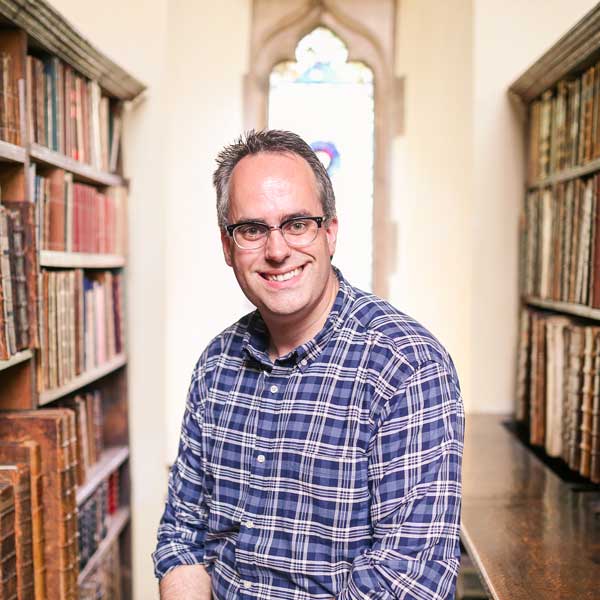
Mark Rankin
2024-27 Stern Center Associate Research Fellow
Professor of English, James Madison University
Ph.D., Ohio State University
E-mail: rankinmc@jmu.edu
Curriculum Vitae
Faculty webpage
Mark Rankin’s research and teaching interests include the literature and history of the English Renaissance and Reformation, especially of the Tudor era (1485-1603); the history of the book and the history of reading; social uses of the book and the printing press to shape the development of elite as well as “popular” culture; John Foxe and the production and influence of his Acts and Monuments, or “Book of Martyrs;” clandestine printing and book smuggling; paleography and manuscript studies; iconography; scholarly editing; and the history of libraries. He has directed or co-directed four National Endowment for the Humanities Summer Seminars for College and University teachers, and is a Fellow of the Royal Historical Society.
He is the co-editor of Henry VIII and His Afterlives: Literature, Politics, and Art (Cambridge, 2009) and co-editor of The Elizabethan Catholic Underground: Clandestine Printing and Scribal Subversion in the English Counter-Reformation (Brill, forthcoming). He is contributing editor of Sermons at Paul’s Cross, 1521-1642 (OUP, 2017), and Editor of the journal Reformation. He was principal investigator of a major National Endowment for the Humanities Scholarly Editions and Translations grant on “The Independent Works of William Tyndale.” He is completing scholarly editions of Tyndale’s The Practyse of Prelates (for the Catholic University of America Press) and The Bale-Cancellar Controversy (for the Renaissance English Text Society). His current research projects include a census-in-progress of the first four editions of Foxe’s Acts and Monuments, and a study of the early readers of Thomas More’s Confutation of Tyndale.
Mark Rankin
2024-27 Stern Center Associate Research Fellow
Professor of English, James Madison University
Ph.D., Ohio State University
E-mail: rankinmc@jmu.edu
Curriculum Vitae
Faculty webpage
Mark Rankin’s research and teaching interests include the literature and history of the English Renaissance and Reformation, especially of the Tudor era (1485-1603); the history of the book and the history of reading; social uses of the book and the printing press to shape the development of elite as well as “popular” culture; John Foxe and the production and influence of his Acts and Monuments, or “Book of Martyrs;” clandestine printing and book smuggling; paleography and manuscript studies; iconography; scholarly editing; and the history of libraries. He has directed or co-directed four National Endowment for the Humanities Summer Seminars for College and University teachers, and is a Fellow of the Royal Historical Society.
He is the co-editor of Henry VIII and His Afterlives: Literature, Politics, and Art (Cambridge, 2009) and co-editor of The Elizabethan Catholic Underground: Clandestine Printing and Scribal Subversion in the English Counter-Reformation (Brill, forthcoming). He is contributing editor of Sermons at Paul’s Cross, 1521-1642 (OUP, 2017), and Editor of the journal Reformation. He was principal investigator of a major National Endowment for the Humanities Scholarly Editions and Translations grant on “The Independent Works of William Tyndale.” He is completing scholarly editions of Tyndale’s The Practyse of Prelates (for the Catholic University of America Press) and The Bale-Cancellar Controversy (for the Renaissance English Text Society). His current research projects include a census-in-progress of the first four editions of Foxe’s Acts and Monuments, and a study of the early readers of Thomas More’s Confutation of Tyndale.
Mark Rankin
2024-27 Stern Center Associate Research Fellow
Professor of English, James Madison University
Ph.D., Ohio State University
E-mail: rankinmc@jmu.edu
Curriculum Vitae
Faculty webpage
Mark Rankin’s research and teaching interests include the literature and history of the English Renaissance and Reformation, especially of the Tudor era (1485-1603); the history of the book and the history of reading; social uses of the book and the printing press to shape the development of elite as well as “popular” culture; John Foxe and the production and influence of his Acts and Monuments, or “Book of Martyrs;” clandestine printing and book smuggling; paleography and manuscript studies; iconography; scholarly editing; and the history of libraries. He has directed or co-directed four National Endowment for the Humanities Summer Seminars for College and University teachers, and is a Fellow of the Royal Historical Society.
He is the co-editor of Henry VIII and His Afterlives: Literature, Politics, and Art (Cambridge, 2009) and co-editor of The Elizabethan Catholic Underground: Clandestine Printing and Scribal Subversion in the English Counter-Reformation (Brill, forthcoming). He is contributing editor of Sermons at Paul’s Cross, 1521-1642 (OUP, 2017), and Editor of the journal Reformation. He was principal investigator of a major National Endowment for the Humanities Scholarly Editions and Translations grant on “The Independent Works of William Tyndale.” He is completing scholarly editions of Tyndale’s The Practyse of Prelates (for the Catholic University of America Press) and The Bale-Cancellar Controversy (for the Renaissance English Text Society). His current research projects include a census-in-progress of the first four editions of Foxe’s Acts and Monuments, and a study of the early readers of Thomas More’s Confutation of Tyndale.

Yuefeng Wu
2026-27 Stern Center Curatorial Fellow
PhD Candidate, Department of the History of Art, Johns Hopkins University
E-mail: ywu247@jhu.edu
Yuefeng Wu’s primary research focuses on fourteenth-century Italy and the broader context of Eurasian exchange during and after the Mongol Empire. His dissertation investigates the representation of global visual and material culture in an illuminated educational manuscript commissioned by a Franco-Genoese merchant, and asks how the European mercantile encounter with the East facilitated the expansion of Latin Christian worldviews and the revision of scholastic approaches to cultural-geographical knowledge. The troubled place of the global object in Western epistemological structures—from medieval encyclopedias to the narrations of universal art history—motivates his thinking and inquiry into the early modern wunderkammer book during his fellowship at the Stern Center.
With an interest in the historiography of art history in relation to other humanistic disciplines, Yuefeng continues to explore the relationship between texts and images, and strives to employ formal and iconological methods in the analysis of broader cultural-historical issues. He has written on illustrated books of the Jesuit mission to China, the representation of Mongol writing in thirteenth-century Italian painting, and he has served as curator of an exhibition on the early modern formation of Renaissance art history at the Clark Art Institute.
Yuefeng Wu’s Curatorial Fellowship has been generously funded by Seyla Martayan in loving memory of her late husband Richard Lan.
Yuefeng Wu
2026-27 Stern Center Curatorial Fellow
PhD Candidate, Department of the History of Art, Johns Hopkins University
E-mail: ywu247@jhu.edu
Yuefeng Wu’s primary research focuses on fourteenth-century Italy and the broader context of Eurasian exchange during and after the Mongol Empire. His dissertation investigates the representation of global visual and material culture in an illuminated educational manuscript commissioned by a Franco-Genoese merchant, and asks how the European mercantile encounter with the East facilitated the expansion of Latin Christian worldviews and the revision of scholastic approaches to cultural-geographical knowledge. The troubled place of the global object in Western epistemological structures—from medieval encyclopedias to the narrations of universal art history—motivates his thinking and inquiry into the early modern wunderkammer book during his fellowship at the Stern Center.
With an interest in the historiography of art history in relation to other humanistic disciplines, Yuefeng continues to explore the relationship between texts and images, and strives to employ formal and iconological methods in the analysis of broader cultural-historical issues. He has written on illustrated books of the Jesuit mission to China, the representation of Mongol writing in thirteenth-century Italian painting, and he has served as curator of an exhibition on the early modern formation of Renaissance art history at the Clark Art Institute.
Yuefeng Wu’s Curatorial Fellowship has been generously funded by Seyla Martayan in loving memory of her late husband Richard Lan.
Yuefeng Wu
2026-27 Stern Center Curatorial Fellow
PhD Candidate, Department of the History of Art, Johns Hopkins University
E-mail: ywu247@jhu.edu
Yuefeng Wu’s primary research focuses on fourteenth-century Italy and the broader context of Eurasian exchange during and after the Mongol Empire. His dissertation investigates the representation of global visual and material culture in an illuminated educational manuscript commissioned by a Franco-Genoese merchant, and asks how the European mercantile encounter with the East facilitated the expansion of Latin Christian worldviews and the revision of scholastic approaches to cultural-geographical knowledge. The troubled place of the global object in Western epistemological structures—from medieval encyclopedias to the narrations of universal art history—motivates his thinking and inquiry into the early modern wunderkammer book during his fellowship at the Stern Center.
With an interest in the historiography of art history in relation to other humanistic disciplines, Yuefeng continues to explore the relationship between texts and images, and strives to employ formal and iconological methods in the analysis of broader cultural-historical issues. He has written on illustrated books of the Jesuit mission to China, the representation of Mongol writing in thirteenth-century Italian painting, and he has served as curator of an exhibition on the early modern formation of Renaissance art history at the Clark Art Institute.
Yuefeng Wu’s Curatorial Fellowship has been generously funded by Seyla Martayan in loving memory of her late husband Richard Lan.
